How to Spot Income Concentration in a Dividend Portfolio
A portfolio can contain many positions while still depending heavily on a small number of them for projected income.
Counting positions is not the same as understanding income diversification. Ten holdings may look broadly spread out, but if two of them provide most of the projected dividends, a change to either one could have a noticeable effect on the income plan.
Income concentration is not automatically a problem. It is a condition worth seeing clearly so that you can decide whether it matches your goals, time horizon, and tolerance for changes in projected cash flow.
Compare each position with the portfolio total
Start with the estimated annual dividend income for each position and the total estimated annual income for the portfolio. A simple concentration calculation is:
For example, if a portfolio projects $4,000 per year and one position contributes $1,200, that position represents 30% of the projected income. The percentage describes dependence on the current estimate; it does not predict what the company will do next.
Look beyond the number of holdings
Income can become concentrated in several ways:
- A high-yield position contributes more income than its position count suggests.
- A large share balance makes one company a major income contributor.
- Several holdings belong to the same industry or economic group.
- Funds or other broad products may contain overlapping exposure.
- A dividend increase raises one position's share of the total without any purchase.
It is useful to consider both income concentration and portfolio-value concentration. A position might represent a modest portion of the account value but a large portion of projected income, or the reverse.
Use payment timing as a second view
Annual concentration is only part of the planning picture. A portfolio may have one major income contributor each quarter, or several positions whose payment schedules create a heavy month followed by a gap.
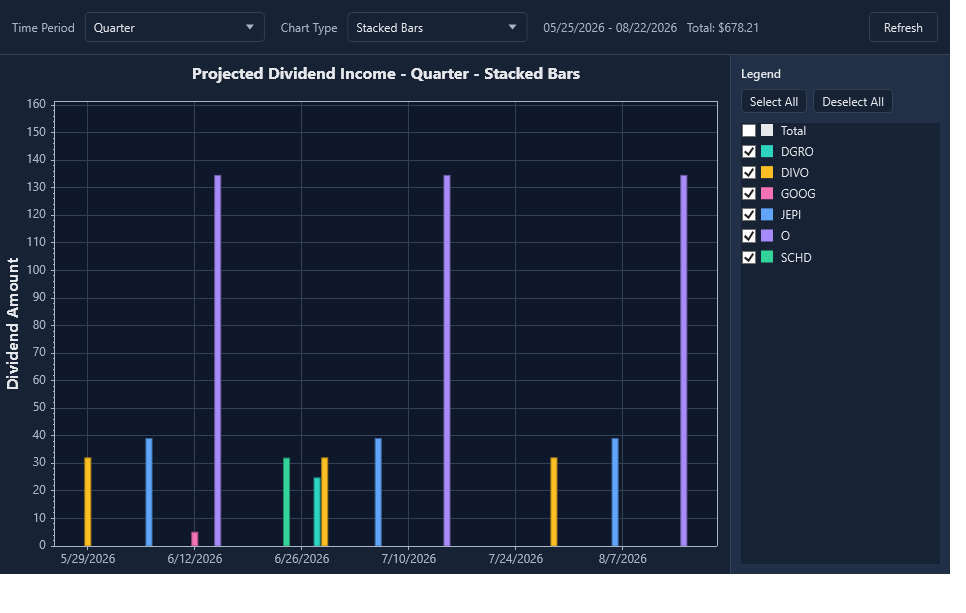
Review the monthly or yearly view alongside the position-level income figures. A portfolio that looks acceptable on an annual basis may still need a closer look if an important bill or planned withdrawal depends on one specific payment period.
Review the assumptions before drawing conclusions
Concentration calculations are only as useful as the data behind them. Check that share quantities, saved dividend amounts, payment frequencies, and recently changed positions are current. If a dividend is reduced, suspended, or paid on a different schedule, the concentration picture can change quickly.
StockTracker's Find Dividend Info feature can help you review possible dividend details for an individual position. The suggested values should still be checked before applying them.
What to do with the result
Use concentration as a prompt for questions, not as an automatic buy or sell signal. You might decide that the concentration is intentional, monitor the position more closely, compare the income plan with other income sources, or discuss the situation with a qualified financial professional.
The useful outcome is visibility: you know which positions matter most to the income estimate and which payment periods would be affected if the saved assumptions change.
Make projected income easier to inspect
StockTracker shows position-level and portfolio-level dividend estimates alongside projected payment timing in one local Windows view.
Try StockTracker free Buy the full versionThe Windows installer is not currently code-signed. Read the installation guidance before opening it.